5 Essential Ballet Barre Exercises for Beginners (With Form Tips)
Before You Begin: Barre Grip and Posture
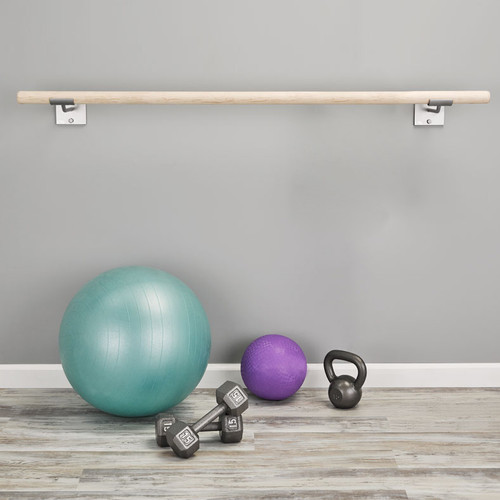
Your relationship with the barre is a light one — fingertips resting on the top of the rail, elbow slightly soft, shoulder down. The barre is a balance aid, not a support beam. If you're gripping it white-knuckled, you're compensating for something in your alignment. Find your balance first; the barre is just there for the moments when you need it.
1. Pliés — The Foundation of Everything
Stand in first position (heels together, toes turned out comfortably). On a count of 4, bend your knees directly over your toes, lowering your body straight down without lifting your heels. On another count of 4, straighten. In second position (feet wider, toes turned out), pliés go deeper.
Common mistake: Letting the knees roll inward. Think "open knees" — the sensation is that you're spreading the floor beneath you.
How many: 4 demi-pliés and 4 grand pliés in first position; repeat in second position.
2. Battement Tendu — Building Footwork and Turnout
From fifth position, brush the working foot along the floor to the front, allowing the heel and then the toe to leave the floor as the foot extends to a pointed position. Return by pulling the heel in first, then the foot. Repeat to the side and back. The sole of the foot should maintain contact all the way to the point — you're extending, not lifting.
How many: 8 to each direction (front, side, back, side).
3. Battement Dégagé — Speed and Precision
The same brushing action as tendu, but faster and the foot just clears the floor (2–4 inches) at its full extension. Because it's faster, mistakes in alignment show up immediately — making it an excellent diagnostic exercise.
Common mistake: Letting the working hip lift when extending to the back. Keep the pelvis neutral and the supporting hip stable.
4. Rond de Jambe — Hip Mobility and Circular Control
En dehors (outward): Start with the foot pointed to the front, then trace a semicircle along the floor to the side, then to the back, then close through first position. En dedans (inward): reverse the direction. This develops the rotational range of motion in the hip socket.
How many: 8 en dehors, 8 en dedans.
5. Grand Battement — Power and Height
From fifth position, brush through tendu, then dégagé height, then swing the leg upward with control — ideally to 90 degrees or higher as strength and flexibility allow. The supporting leg stays absolutely straight. Important: Height is secondary to control. A 70-degree grand battement with a perfectly stable pelvis is better technique than a 110-degree kick that tilts the whole body.
A Simple 20-Minute Beginner Barre Routine
- Warm-up: gentle pliés in parallel, 2 minutes
- Pliés in 1st and 2nd position
- Tendus front, side, back, side
- Dégagés front, side, back, side
- Rond de jambe en dehors and en dedans
- Grand battement front, side, back, side
- Balance in relevé on two feet, then one foot